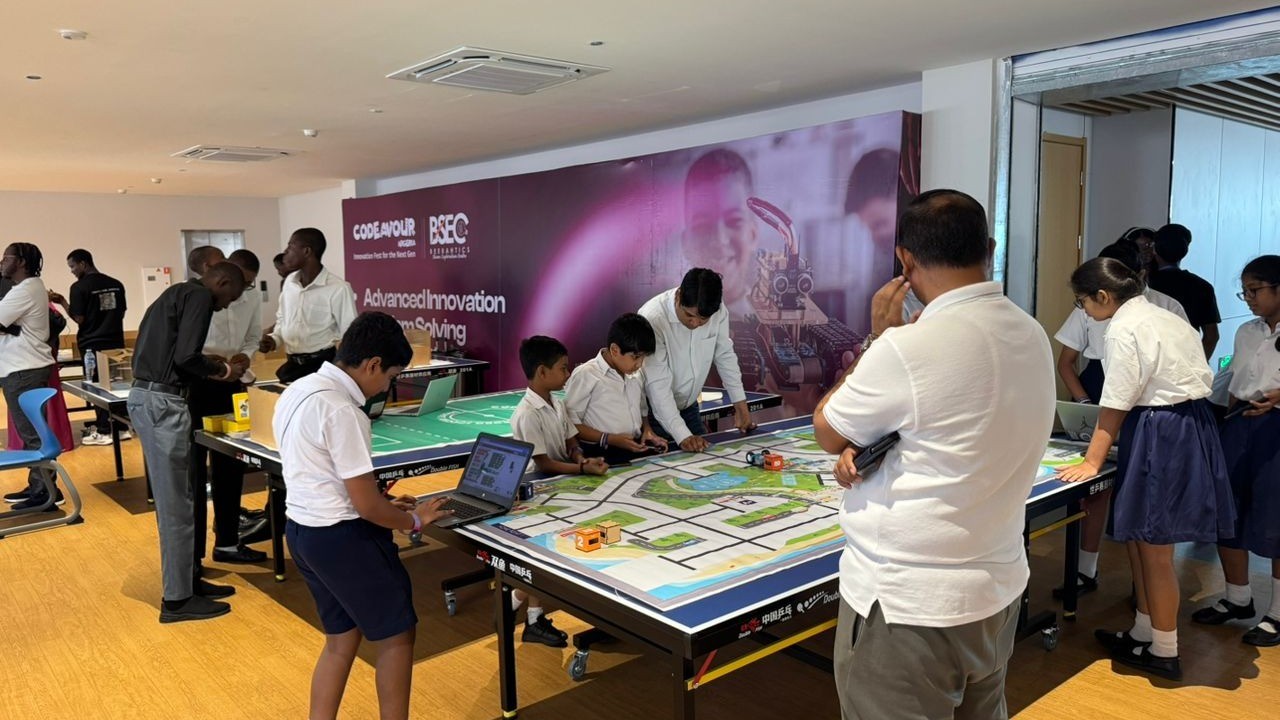
Last weekend Charterhouse Lagos hosted the Codeavour National Championships. Watching students work through their projects was a powerful reminder that technology competitions are rarely just about coding.
More Than Coding: The Power of Student Innovation

John Todd
- Blog
- 13 March 2026

Content table
Last weekend Charterhouse Lagos hosted the Codeavour National Championships. Watching students work through their projects was a powerful reminder that technology competitions are rarely just about coding.
What stands out most is the way students approach a problem. They test ideas, change direction, collaborate with one another, and keep refining their thinking until something begins to work. The code matters, of course, though what really becomes visible is curiosity in action.
Curiosity and confidence
When young people are given the opportunity to experiment, explore, and build something themselves, their relationship with learning changes. They begin to see knowledge not simply as information to absorb, but as a set of tools that help them understand and shape the world around them.
That shift matters. It encourages independence of thought and the confidence to ask better questions.
Events like Codeavour provide a glimpse of this process. Students take ownership of a challenge and begin to think like problem-solvers rather than simply learners.
Problem-solving as a habit
The future students are preparing for will demand more than technical skills alone. It will require analytical thinking, adaptability, creativity, and the resilience to keep working when solutions are not immediately obvious.
These habits develop gradually. They grow in environments where students are encouraged to try ideas, test them, and reflect on what they learn from the process.
Technology competitions can make this visible, though the deeper work happens every day in classrooms where questioning, experimentation, and curiosity are encouraged.
Connecting innovation and academic foundations
Innovation is often presented as something separate from academic study. In practice, the strongest innovators usually have deep foundations in mathematics, science, and logical reasoning.
At Charterhouse Lagos, these foundations are developed steadily across the school, preparing students for the academic demands of Year 10 (IGCSE) and later Year 12 (A level). When strong academic preparation is combined with curiosity and creativity, students begin to see how knowledge can be applied in meaningful ways.
The result is not simply technical competence, but a growing sense of confidence about tackling complex problems.
A generation ready to build
Nigeria’s young people already demonstrate remarkable energy and creativity, particularly in technology and innovation. Events such as Codeavour offer a glimpse of that potential.
Students are not only learning about technology. They are beginning to imagine how they might use it.
For educators, moments like this are a reminder that schools should do more than transmit knowledge. They should create environments where curiosity is encouraged, ideas are tested, and students feel confident exploring new possibilities.
Looking ahead
The most encouraging aspect of events like Codeavour is not the competition itself. It is the reminder that when curiosity, strong academic foundations, and thoughtful guidance come together, students develop the confidence to create rather than simply consume.
Families who would like to see this culture of curiosity and academic ambition in action are warmly invited to visit Charterhouse Lagos. Our admissions team welcomes conversations with families exploring Primary, Secondary (including Year 7 entry), and the pathways that lead to Year 10 (IGCSE) and Year 12 (A level). Families with students for Year 10 entry may also wish to consider applying for our academic scholarship.
#CharterhouseLagos #BritishEducation #STEMEducation #IGCSE #ALevels #Innovation #EducationInNigeria #FutureReady