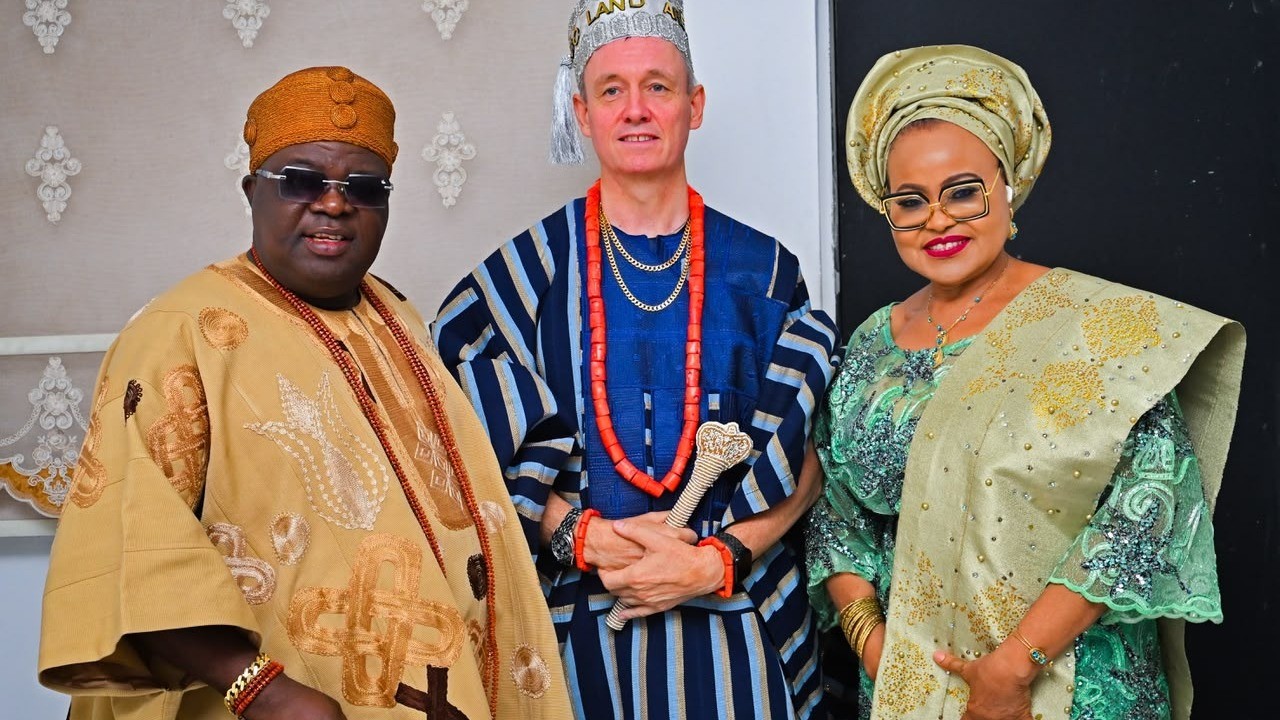
Recently, I had the great privilege of being conferred with the honorary title of Aare Oluko of Ogombo Kingdom. It was a very special occasion personally, but it also caused me to reflect on the relationship that has developed between Charterhouse Lagos and the community around us.
Anchoring International Education: Leadership, Culture and Belonging

John Todd
- Blog
- 26 August 2026

Content table
A moment to reflect
Recently, I had the great privilege of being conferred with the honorary title of Aare Oluko of Ogombo Kingdom. It was a very special occasion personally, but it also caused me to reflect on the relationship that has developed between Charterhouse Lagos and the community around us.
When we first came to Ogombo, we came with plans to build a school. Inevitably, much of our attention was focused inwards: designing the campus, recruiting staff, establishing systems and thinking about the education we wanted to provide. But schools do not exist in isolation. As the buildings have gone up and the school has opened and grown, our relationship with the place around us has developed too.
That relationship matters. We employ people from the local community, work with local businesses and suppliers, and depend upon local knowledge and relationships in ways that are sometimes easy to overlook. Security is a good example. We have our own professional security arrangements, of course, but being known, understood and supported within the wider community is another important part of keeping a school safe. At the same time, we have responsibilities as a significant employer and institution within that community. The relationship works in both directions.
I was particularly grateful and honoured that the Secretary to the Lagos State Government joined us for the ceremony. Her presence was significant, and reflected another relationship that has developed as the school has grown. We have been grateful for the support our school has received from the Lagos State Government throughout its development. Charterhouse Lagos is physically located in Ogombo, but it also sits within Lagos State and within the wider educational landscape of Nigeria. That raises a bigger question for me. What does it mean for an international school not simply to operate successfully in a country, but genuinely to become part of the place in which it operates?
Anchoring works both ways
I have spoken previously about the idea of anchoring in education. Education develops knowledge and skills, but it also helps form identity, relationships and a sense of connection to place. Where young people are educated influences where their friendships and networks develop, where they imagine their futures and, ultimately, where they feel they belong.
That has particular significance for Nigeria. There are many understandable reasons why Nigerian families choose education overseas for their children, and international experience will continue to be important. But I have argued that we also need excellent education here in Nigeria which allows young people to develop a genuinely global outlook without becoming disconnected from their own country. The phrase I have used previously is “global educational capital with deep national grounding”.
Thinking about Ogombo has made me consider the other side of that argument. If education can anchor young people to a place, what anchors an international institution to the country and community in which it operates? We cannot reasonably encourage students to develop a sense of connection and responsibility to Nigeria while the institutions educating them remain somehow detached from it.
There is an idea within the International Primary Curriculum that I have always valued: the relationship between home country and host country. At its heart is respect. Children should understand their own culture and identity, while learning to understand and respect the culture, perspectives and experiences of the place in which they are living. For me, that idea applies just as strongly to international schools themselves.
An international school inevitably brings something from elsewhere. In our case there is a long British educational tradition, established values and expectations, and experience drawn from schools and educators around the world. There is nothing wrong with being confident about what we bring. But the cultural exchange cannot be one way. Living and working in Nigeria should also change us. We need to listen to Nigerian colleagues and families, understand the communities around us, learn how relationships work here and recognise that our host country has things to teach us too. That process does not weaken an international identity, it gives it roots.
Belonging brings obligations
If anchoring is about more than simply occupying a place, then it must eventually create obligations. It is relatively easy for a school to talk about community engagement. The more difficult question is whether the institution genuinely sees itself as having responsibilities beyond the people who pass through its gates each day.
Those responsibilities begin very locally. A school of our size creates employment, both directly and indirectly. It buys goods and services. It creates opportunities for local businesses and brings investment into its immediate environment. There are also opportunities to share expertise, facilities and experience. Some of these contributions are obvious and measurable; others develop more slowly through relationships and trust.
But reciprocity matters here. It would be wrong to frame the relationship as a well-resourced school simply giving something to the community around it. We benefit from that community every day. Our local colleagues bring knowledge, skills and understanding to the school. Local relationships help us navigate challenges. The support and goodwill of those around us contribute to our security and stability. We are not simply doing things for a community; we are increasingly part of one.
That changes the nature of the obligation. “Giving back” can sometimes sound optional, something an organisation chooses to do when circumstances permit. Belonging is different. If an institution is genuinely anchored in a place, contributing to that place becomes part of what responsible leadership looks like.
From Ogombo to Lagos
The same principle applies as we widen the circle. Charterhouse Lagos is part of Ogombo, but we are also part of Lagos. We operate within the state’s economy, employ its people and educate its young people. We therefore need to understand where we fit within its wider educational and development ambitions.
For an independent school, independence should never mean disconnection. Lagos has an enormous and complex education ecosystem, encompassing government and private schools, universities, training institutions, employers, professional organisations and government itself. We are one relatively small part of that landscape. We should be confident about what we can contribute, but equally realistic about our scale and willing to learn from others.
This is where partnership becomes important. Teacher and leadership development is one obvious area. So too are safeguarding, professional standards, educational innovation and the sharing of expertise. There will be others that emerge as relationships develop. The point is not that one school arrives with the answers. It is that a school with significant resources, expertise and international connections should ask how those assets might contribute to the system around it.
There is also value in understanding the priorities of government. The Lagos State Government’s THEMES+ agenda places education within a much broader picture of economic and social development. That matters. Education does not sit separately from employment, security, infrastructure, health or economic opportunity. If we are serious about being a Lagos institution, we should be asking where our work connects with those wider ambitions and where useful partnerships might be possible.
The support we have received from Lagos State makes that question more important, not less. Partnership should also be reciprocal. As our school becomes more established, part of our responsibility is to consider how we can contribute to the development of the state that has supported our own development.
Anchored in Nigeria
The final circle is Nigeria itself. This takes me back to the argument I have made previously about human capital and national anchoring.
For many years, international education has understandably emphasised mobility. We celebrate students progressing to leading universities around the world and preparing them to compete successfully in a global environment. We should continue to do so. But global opportunity and national commitment do not have to be opposites.
The deeper question is what happens to the human capital we help develop. Where do young people form their strongest relationships? Where do they build the networks that may later become professional partnerships, businesses and institutions? Where do they imagine creating their futures? Education plays a significant role in shaping those answers.
That is why I believe high-quality international education within Nigeria matters to national development. If young Nigerians can receive an education of genuinely international quality here, they can develop global confidence and connections while retaining a much stronger relationship with home. They can see Nigeria not simply as somewhere they come from, but as somewhere in which they might build, lead, invest and contribute.
But again, the obligation cannot rest solely with the students. The institutions educating them must consider their own contribution to national capacity. We develop teachers and school leaders. We employ people and invest in professional development. We can strengthen standards and systems. We can create partnerships and networks. We can bring international experience into Nigeria while also taking Nigerian experience into international conversations.
None of that means claiming that an individual school is transforming a country. Nigeria’s educational challenges and opportunities are far larger than any one institution. But neither should that become an excuse for institutions to think only about themselves. National development is ultimately the cumulative result of many organisations and individuals deciding that they have a part to play.
What it means to be anchored
Perhaps this is ultimately what anchoring means for an international school. It is not simply having a campus in a particular country, employing local staff or teaching some elements of local culture. It is developing relationships deep enough that the institution begins to understand itself as having a stake in the future of the place around it.
That does not require us to become less international. I would argue the opposite. The best international education should allow different traditions, experiences and perspectives to meet without requiring one to displace the other. We can remain confident in the educational traditions and standards we bring while allowing our understanding of education and leadership to be enriched by Nigeria.
The relationship between home country and host country therefore becomes more than something we teach children. It becomes something the institution itself has to live. Respect develops into relationship; relationship creates reciprocity; and, over time, reciprocity creates a deeper sense of belonging.
Receiving the title of Aare Oluko of Ogombo Kingdom has made me think more carefully about that journey. I am deeply grateful for the honour, but its significance for me lies particularly in what it represents: a relationship with a community that began when we arrived with plans to build a school and which has developed as that school has become part of the landscape around it.
Perhaps that is one measure of successful international education. Not simply whether an institution can establish itself and flourish in another country, but whether, over time, it can put down roots, accept the obligations that come with belonging, and make a meaningful contribution to the community, city and country it calls home.